Blog 1: How Many Active Trading Positions Should You Hold Concurrently? Controlling Exposure in Active Trading
Introduction
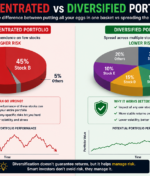
One of the most common tactical errors in active trade management is either over-concentration or under-diversifying. Both can silently erode trading capital and damage long-term execution consistency.
Many traders assume that a higher number of active trades translates to more profit opportunities. In reality, managing too many trades simultaneously leads to a loss of operational focus, execution slippage, and excessive, uncoordinated market exposure.
A practical approach is to maintain a limit of 4 to 8 active trades at any given time. This range provides sufficient risk distribution across different setups without diluting your focus or execution speed.
Why Too Many Positions Can Be Harmful
Holding too many trades creates a false sense of security, but frequently leads to operational risks:
- Lack of proper monitoring: Tracking multiple charts, technical indicators, and stop-loss levels in real-time becomes overwhelming.
- Overexposure to market direction: If all positions are highly correlated with the main index, you are not hedged; you are simply taking on highly leveraged market risk.
- Sector correlation risk: Holding several active trades in the same sector exposes your capital to sudden industry-wide news or shocks.
- Reduced conviction: Trading capital is diverted from your high-probability setups to average, low-conviction setups.
When you are spread too thin, you are not managing trades—you are merely reacting to intraday volatility.

The Risk of Holding Too Few Positions
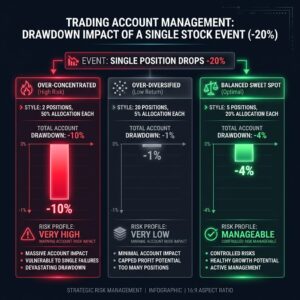
At the other extreme, having only 1–2 positions creates extreme risk profile:
- High dependency on a single outcome: A single stop-loss hit or gap-down can erase a large percentage of your weekly/monthly trading gains.
- Emotional pressure: Every minor tick against your position triggers anxiety, leading to premature exits or stop-loss violations.
- Inconsistent equity curve: Your trading account experiences massive drawdowns and sharp peaks instead of steady, structured growth.
A single wrong trade in an under-diversified active trading setup can impact both your trading capital and your execution confidence.
Position Sizing: The Real Game Changer
While the number of positions matters, capital allocation per trade matters even more.
For New Traders:
- No single position should exceed 10% of total trading capital.
- This helps:
- Control downside risk per trade.
- Reduce emotional stress.
- Allow learning without risking catastrophic trading account drawdowns.
For Experienced Traders:
- Position size can go up to 15–20% in high-conviction setups.
- But only when:
- The setup is technically mature and validated.
- Risk is predefined and mathematically calculated.
- The decision is system-based rather than emotional.
Market Conditions Should Guide Your Exposure
Your exposure should adapt to the market, not stay fixed.
- Strong trends: Slightly higher positions (up to the 8-position mark) to ride the momentum.
- Sideways markets: Reduce exposure (keep only 3-4 active trades) to avoid getting chopped up in range-bound price action.
- Volatile phases: Focus on capital protection by maintaining higher cash levels.
Sometimes, the best decision is to not trade at all.
Quality Over Quantity
The goal is not to participate in every move, but to participate in the right moves. A focused list of active trades with disciplined allocation often performs better than a scattered one.
Consistency comes from selectivity, execution discipline, and strict risk control.
Final Thought
It’s not about how many trades you take—it’s about how well you manage them. Discipline in allocation, patience in execution, and clarity in decision-making separate consistent traders from the rest.