Blog 2: How Much Risk Should You Take in a Single Trade? The Science of Position Sizing
Introduction
Risk is the most misunderstood aspect of trading.
Most traders spend their time searching for high-return opportunities, but very few focus on how much they can afford to lose on a single trade. The reality is simple: long-term success in trading is not defined by how much you make, but by how well you control your losses.
Why Risk Management Matters
Losses are an unavoidable part of trading. What separates consistent traders from the rest is:
- How small they keep their losses.
- How quickly they recover.
- How disciplined they remain during drawdowns.
Without proper risk control, even a few wrong trades can erase weeks or months of gains, damage confidence, and lead to emotional, impulsive decisions.
Ideal Risk Per Trade
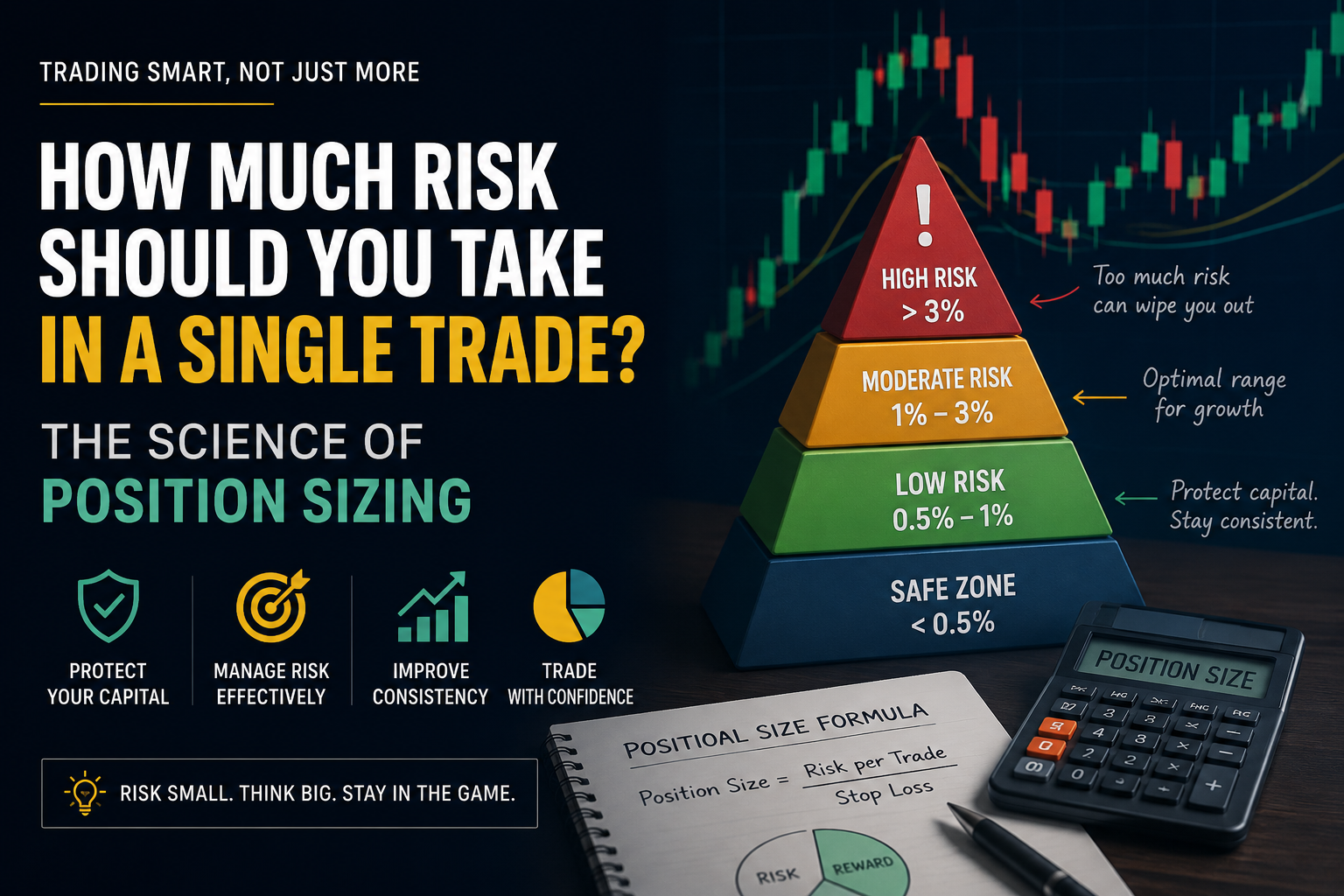
A disciplined approach is to risk 1% to 3% of your total capital per trade.
For New Traders:
- Stick to 1%–2% risk per trade.
- This helps:
- Protect capital during the learning phase.
- Reduce emotional stress.
- Maintain consistency.
For Experienced Traders:
- Can go up to 2%–3% in high-quality setups.
- But only when the trade structure is clear, stop-loss is well-defined, and position sizing is calculated properly.
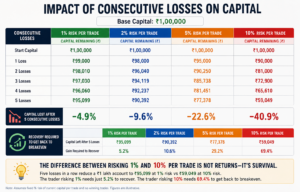
Figure 2.1: The Power of 1% Risk,2% risk, 5% risk vs. 10% Risk Capital Curves during Drawdowns
The Hidden Danger of High Risk
Many traders take 10% risk per trade, especially after a few winning trades. This creates a dangerous cycle where one loss wipes out multiple gains, emotional pressure increases, and decision-making rapidly deteriorates. Taking on 10% risk per trade is mathematically unsustainable for active trading accounts.
👉 The Reality of Consecutive Losses: In active trading, experiencing a series of 2 to 3 consecutive losses is mathematically normal. Let’s look at how such a streak impacts your account under different risk models:
- With 10% Risk Per Trade: Just 5 consecutive losses will instantly wipe out 40.90% of your total trading capital. Once your account experiences a 30% drawdown, you need a massive 69% gain on your remaining capital just to break even—a steep hill that often triggers emotional trading, revenge trading, and eventual account blow-up.
- With 1% Risk Per Trade: The same 5 consecutive losses result in a minor 4.90% drawdown. Breaking even from a 3% dip requires a simple 5.20% gain, which is easily achievable in a single standard trade without any psychological stress.
Risk vs. Position Size (An Important Distinction)
Risk is not about how much money you invest—it’s about how much you are willing to lose if the trade goes wrong.
- Large position + tight stop: Controlled risk.
- Small position + no stop: Unlimited risk.
This is why every trade must have a defined stop-loss, proper position sizing, and a clear invalidation level.
Figure 2.2: Identifying Clear Entry, Stop Loss, and Profit Targets on a Candlestick Chart
Alt text: Entry and stop-loss placement in technical trading
How to Calculate Risk in a Trade
Understanding risk is not enough—you must be able to calculate it before entering any trade.
👉 Basic Formula:
Position Size (Quantity) = (Total Capital × Risk %) ÷ (Entry Price – Stop Loss Price)
🧮 Concrete Example:
- Total Capital = ₹1,00,000
- Risk % = 1% ( ₹1,000 allowed loss)
- Entry Price = ₹100
- Stop Loss = ₹95
- Risk per share = ₹5
- 👉 Allowed Position Size = ₹1,00,000 × 1% = ₹1,000 allowed risk; ₹1,000 ÷ ₹5 = 200 shares
This ensures that even if the stop loss is hit, you lose exactly 1% of your capital ( ₹1,000), not a rupee more. That’s how disciplined traders survive losing streaks.
Common Mistakes vs. Correct Approach
❌ The Retail Trap: Decide quantity first → Ignore proper stop loss → Hope the trade works.
✔ The Professional Approach: Define stop loss first → Calculate risk based on capital → Determine exact position quantity.
Market Conditions and Adaptability
Risk should adapt to the market environment. In trending markets, normal risk (2-3%) can be deployed. In sideways or highly volatile phases, reduce risk per trade to 0.5% – 1% or stay in cash to protect your capital base.
Final Thought
The goal in trading is not just to grow capital—it is to protect it while growing. In trading, survival is the first objective. Profitability is the result of disciplined survival.
Want structured, risk-managed trade setups from SEBI Registered Research Analyst at Momentum Edge?
Explore Our Plans
Disclaimer: Investment in securities markets is subject to market risks. Read all related documents carefully before investing. SEBI Registration No. INH000025948. The views expressed in this article reflect the personal opinions of the Research Analyst based on publicly available information and are subject to change without notice.